

Payment Gateway Vs. Payment Aggregator Know the difference
Online purchases have become an integral part of daily life; online payments become more common to keep pace with it. Merchants of any size and industry want their website/app or access to an online marketplace. Whether it is their website, app, or any marketplace, online payment is a must for all. The end-users are now used to digital payments. And when it comes to online payments, Payment Gateway vs. Payment Aggregator are the most similar yet confusing terms in the fintech market.
Are you a merchant looking for a payment solution?
Are you also under the Payment gateway Vs. Payment aggregator confusion?
If your answer is yes, you have landed on the correct page. We understand that these two terms are intertwined, and we are here so that you can have clarity on these two terminologies of digital payments.
Scroll down for payment gateway vs. payment aggregator – a complete comparison. Let us begin with the definitions
What Is A Payment Gateway?
Payment gateway is basically a software application through which one party can pay, and the other can receive money online. As the name suggests, it is a gateway between the beneficiary and sender accounts.
What Is A Payment Aggregator?
On the other hand, payment aggregator (also known as merchant aggregators) is the inclusion of all the payment gateways. These help merchants in processing payments and accept payments through any bank transfer without having a merchant account. So, merchants get a unique MID with the payment aggregators and they can accept payments without setting up accounts in multiple banks, all the card service providers, and payment service providers.
Payment Gateway Vs. Payment Aggregator: How Do Payment They Differ From Each Other?
So, the definition says that payment gateways and payment aggregators have almost similar objectives; however, each comes with distinctive features. Now, that's all about the definition - let's delve into the comparison between payment gateways and payment aggregators
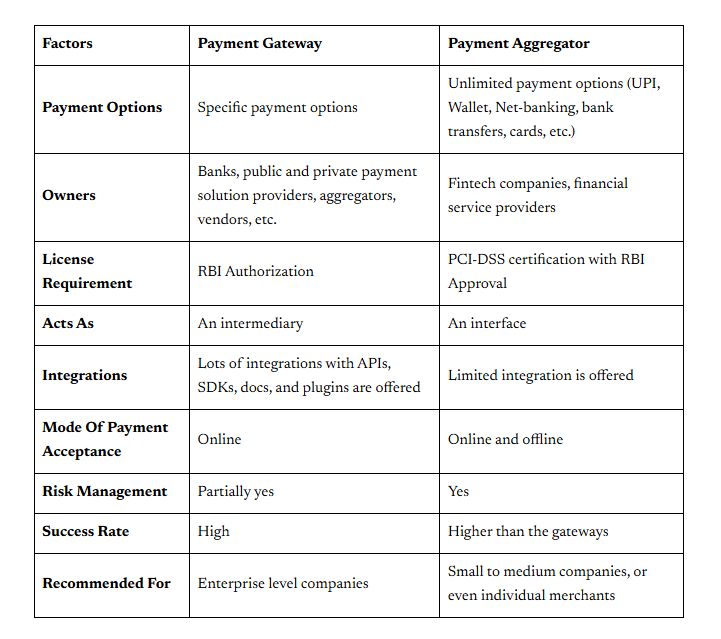
At present, some digital payment companies are allowed to function as payment aggregators as well as payment gateways with some banks.
Still confused with payment gateway and payment aggregator differences? Have a look at the highlights of both:
Highlights of Payment Gateways
- Authorizes the transaction
- Quick and sage transactions
- End-to-end encryption for power-packed security
- Fraud detection from a reliable database and protection
- Multiple payment methods
- Integrations with docs
- Complete dashboard reporting with analytics
- An outstanding checkout experience
- High volume transactions allowed
- Decent success rate – almost no congestion problem
Highlights of Payment Aggregators
- Simple and quick merchant account creation
- Overall simplicity and convenience – a complexity-free solution
- Risk management (chargeback, refund, etc. responsibility)
- Strict underwriting process
- Flexible integrations
- Integrated settlement process
- Decent reporting and analytics
- Fraud detection from a reliable database and protection
- Trend alerts
- Customer support
Payment Gateway Vs. Payment Aggregator – Which Is The Best For Your Business?
At present, seeing the increasing level of fraudulent activities, it can be said that a payment gateway is not at all sufficient for any online business. Payment gateways work closely with the banks that issue merchant accounts. This is where payment aggregators come into the game. Payment aggregators work with these acquiring banks and help in processing the payments.
So, ideally, you choose a payment gateway with the approval to work as a payment aggregator to accept safe payments seamlessly. A payment gateway takes pride in its checkout experience, which you cannot neglect. As a result of this factor, an end-user should have a satisfactory feeling after making a payment, and you cannot achieve it without a payment gateway. At the same time, a payment aggregator offers the ease of merchant account, which you again cannot miss.
End Words
In conclusion, a growing business should always go for a payment gateway, and it is best if that gateway has the approval of working as a payment aggregator. A small merchant of the present day always has the potential to make it big in a few months or years. So, we always have to look for long-term results, and that's why a perfect financial solution will be a combination of a payment gateway and a payment aggregator.
In case you are looking for optimum growth potential in the coming days, go for this hit combination and present an outstanding checkout experience with lightning-fast transactions and safety to your customers. Alternatively, you can go for a payment aggregator for the time being. In the future, when you have a more profitable business, you can upgrade your payment solution – the upgrade option is always open, and you can choose an upgrade based on your budget. Till then, you may stay with a payment aggregator. However, you can get a private payment gateway with RBI approval of the payment aggregator under decent pricing – you can try that out, too.