

PCI-DSS Compliance: Definition, Levels, Importance, and More
While looking for an online payment solution for own business, almost all of us come across the term "PCI-DSS Compliance." But how many of us clearly understand what it is and its purposes?
Relax! From today onwards, you will have a crystal-clear idea of PCI-DSS Compliance and make wiser decisions in the coming days.
What Is PCI-DSS Certification or Compliance?
The full-form of PCI-DSS is Payment Card Industry Data Security Standard. PCI-DSS certification is basically a written set of security standards for merchants to accept payments through cards. PCI-DSS denotes an extra level of security that makes the merchants more reliable to their customers. It aims to secure the card and its sensitive data to minimize the chances of fraudulent activity.
In 2006, Payment Card Industry Security Standards Council (PCI SSC) introduced a set of security standards to be followed by the merchants who use the card data of their buyers for transaction purposes. These standards altogether make PCI-DSS. This council wanted to bring the businesses under the best security practices that can introduce trustworthiness among the customers. Right now, it is a must-have for any payment gateway.
How does PCI-DSS Compliance Work?
PCI-DSS is not a one-time process, rather, it is a continuous process that occurs every time a merchant starts accepting a card transaction. It is to be mentioned here that the card data are highly sensitive, and while handling the cardholder data, the company has to fulfill the conditions of PCI-DSS.
Moving on to its workflow, it starts with an identification of everything (both the assets and processes) that will handle cardholder data. Next, it conducts an analysis of whether there is any vulnerability or not. Then, it proceeds with the necessary repairs/fixes to strengthen data security to its expected level and this process ends with documentation of the entire process (from the risk identified to the fixes made).
What Are the Levels of PCI-DSS Compliance?
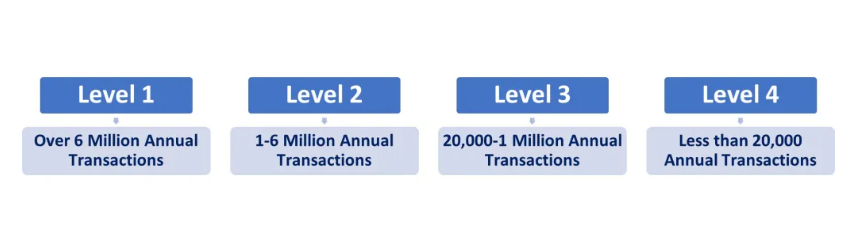
The council understands that not all organizations hold equal levels of risk. Therefore, based on the number of card transactions an organization does, they defined four different levels.
The levels of PCI-DSS and their details are mentioned in the chart below:
Goals of PCI-DSS Compliance
The main purposes or goals of PCI-DSS Compliance are to
- Create a secure network and system for all card transactions
- Secure the card data
- Stay away from spyware, malware, bugs and other vulnerabilities
- Bring in a strong access control
- Test the networks to ensure the latest updates are implemented
- Retain a formal information security policy
Requirements of PCI-DSS Compliance
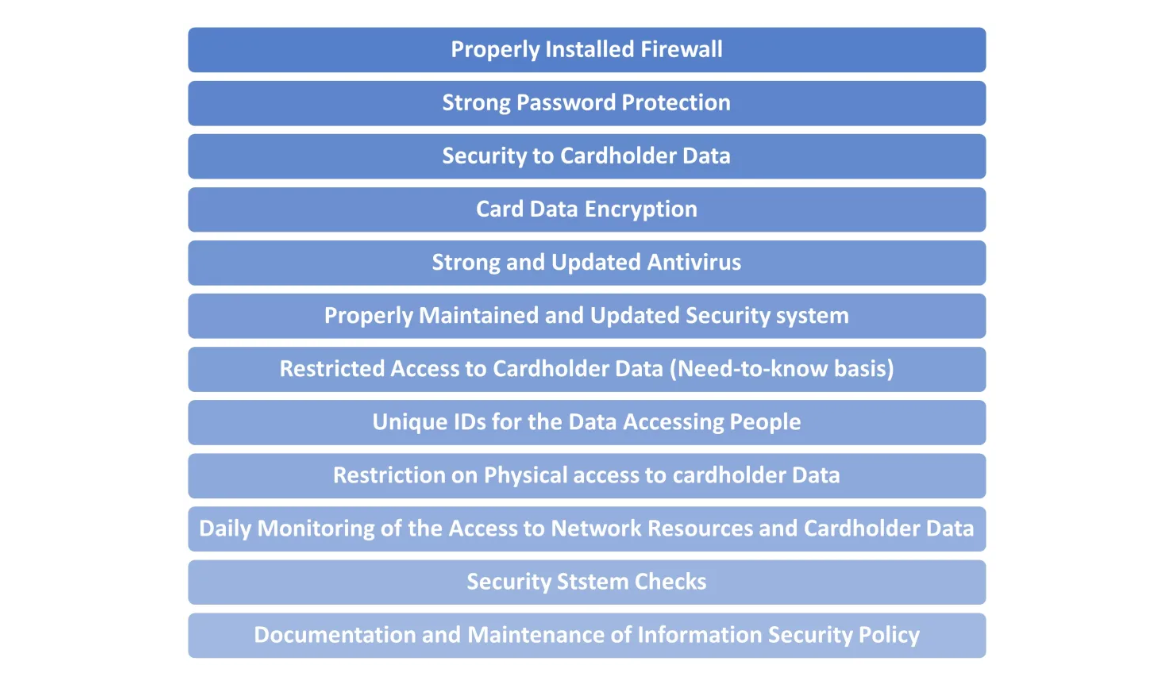
Based on these goals, PCI-DSS Compliance comes with specific requirements. Take a look at these:
Who Is Subject To PCI-DSS?
This is a common question among almost everyone, and the answer is anyone (merchant) who uses an individual's card data. For online or offline transactions, any business that accepts card payments is subject to PCI-DSS Compliance.
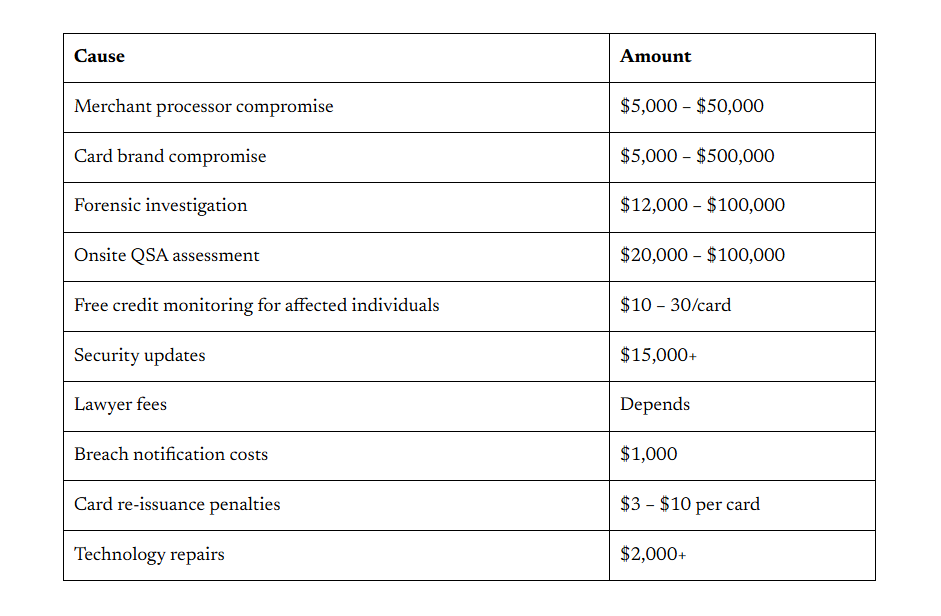
Not just that, a merchant must agree to pay the fine if they are not compliant with PCI-DSS when signing the contract with a payment processor; however, this fine may vary based on the processor, which can be $5000-1,00,000.

Benefits/Importance of PCI-DSS Compliance for Your Business
Now, you might be wondering, "Why do I need to become PCI-DSS compliant?"
Don’t worry, you don’t need it if you only transact in cash with your customers. But, you have to be PCI-DSS compliant in case you are handing card data of your customers while accepting payments from them. Unless you meet the standards, you will have to pay hefty fines.
Apart from saving you from these fines, here are some benefits PCI-DSS Compliance offers to your business:
- Increases the credibility of your brand
- Retains your reputation
- Provides confidence to your buyers to transact with you
- Helps in gaining customer loyalty
- Brings more business opportunities
- Saves from trust loss of the customers
- Keeps you away from legal disputes and bankruptcy
How To Achieve PCI-DSS Compliance?
Therefore, PCI-DSS Compliance holds huge importance for any business that accepts online payment through cards. If you have one such business, then you must become PCI-DSS compliant.
But before you know the process, you need to know, "Which will be the IDEAL PCI-DSS level for Your business?”
Right now, most of the businesses opt for levels 2, 3, and 4. You can select the level with a complete understanding of the annual number of transactions. Once you know the level, follow these steps:
- Create a flow of the network connections, systems, and applications through which you will handle the cardholder data
- Check the 12 requirements of PCI-DSS Compliance and analyze your security protocols and configurations
- Select the most appropriate Self-Assessment Questionnaire (SAQ) form and complete filling it
- Secure your network connection to protect cardholder data
- Attest the compliance to confirm the results
- Submit the copy
- Monitor the system daily
- Update the systems when needed
Not PCI-DSS Compliant? Know the Consequences
Currently, you can face bankruptcy for not having PCI-DSS Compliance. Just have average fines:
In addition to all these, the business will lose customer trust, which may take years to recover. So, it is better to become PCI-DSS compliant to avoid these consequences.
The Possible Challenges
Even after being the global security standards, some challenges exist to obtain PCI-DSS Compliance, especially for the small to medium merchants from Growing India. These challenges are:
- Complexity
- Cost
- Emerging threats and changing requirements of compliance
Do Small Businesses Need PCI-DSS Compliance?
Businesses, irrespective of their sizes, need PCI-DSS Compliance if they are accepting card payments. Today, entrepreneurs accept payments through UPI, cards, wallets, net-banking, to offer complete payment ease to their customers so that their customers can pay easily on liking the products.
Customers, even after barely having an idea of what PCI-DSS is, prefer transacting with merchants that have this compliance. Therefore, these merchants also need to be PCI-DSS compliant to retain these customers.
Remember: If you fail to meet the standards, then you may be subject to termination of your rights to accept payments through cards. As a result, your business may become inaccessible to the target customers and face a huge loss, especially for the growing merchants.
It is highly recommended to small businesses to get their compliance with a proper understanding of annual card transactions to get rid of non-compliance fines and other consequences.
Become PCI-DSS Compliant with PayG Payment Gateway
In order to keep your business updated with the global standards, it is essential to have PCI-DSS Compliance. It is very common today for businesses to take the help of a payment gateway to receive smooth payments through UPI, Cards, net-banking, wallet, etc.
If you are looking for the best payment gateway with PCI compliance in India, you can visit PayG. At this point, when you opt for PayG Payment Gateway, it becomes much easier for you to achieve your compliance. Being a PCI-DSS compliant payment gateway, it offers fraud prevention and 3D security to prevent all the card data and strictly follows the compliance guidelines. So, you can have peace of mind as PayG will give you the safest way to collect cardholder data. So, relax and get ready to grow your business.